
Cost guide
Temporary roof costs: what you are actually paying for
A temporary roof is a designed structure, not an accessory — which is why it is priced separately from the scaffold beneath it. This guide explains how temporary roofs are costed, what pushes the price up or down, and how to work out whether one will save you money on your project.
- 48hrs
- Site visit
- 24hrs
- Phone answered
- 25yrs
- In the industry
The short answer
- A temporary roof is priced on the covered plan area, the clear span it has to achieve, and the length of the hire — on top of the base scaffold that supports it.
- The base scaffold is the larger part of most quotes. UK scaffolding hire averages around £20–£25 per m², and the roof sits on top of that.
- Long clear spans are the single biggest cost driver, because they need heavier aluminium beams and, above a certain span, a designed solution with calculations.
- Weather protection almost always pays for itself on a re-roof, a structural timber repair or any project where water ingress would damage what is underneath.
- ATC does not publish fixed rates for temporary roofs. Every one is designed for the building it sits on, and the site visit and written quote are free.
What a temporary roof actually is
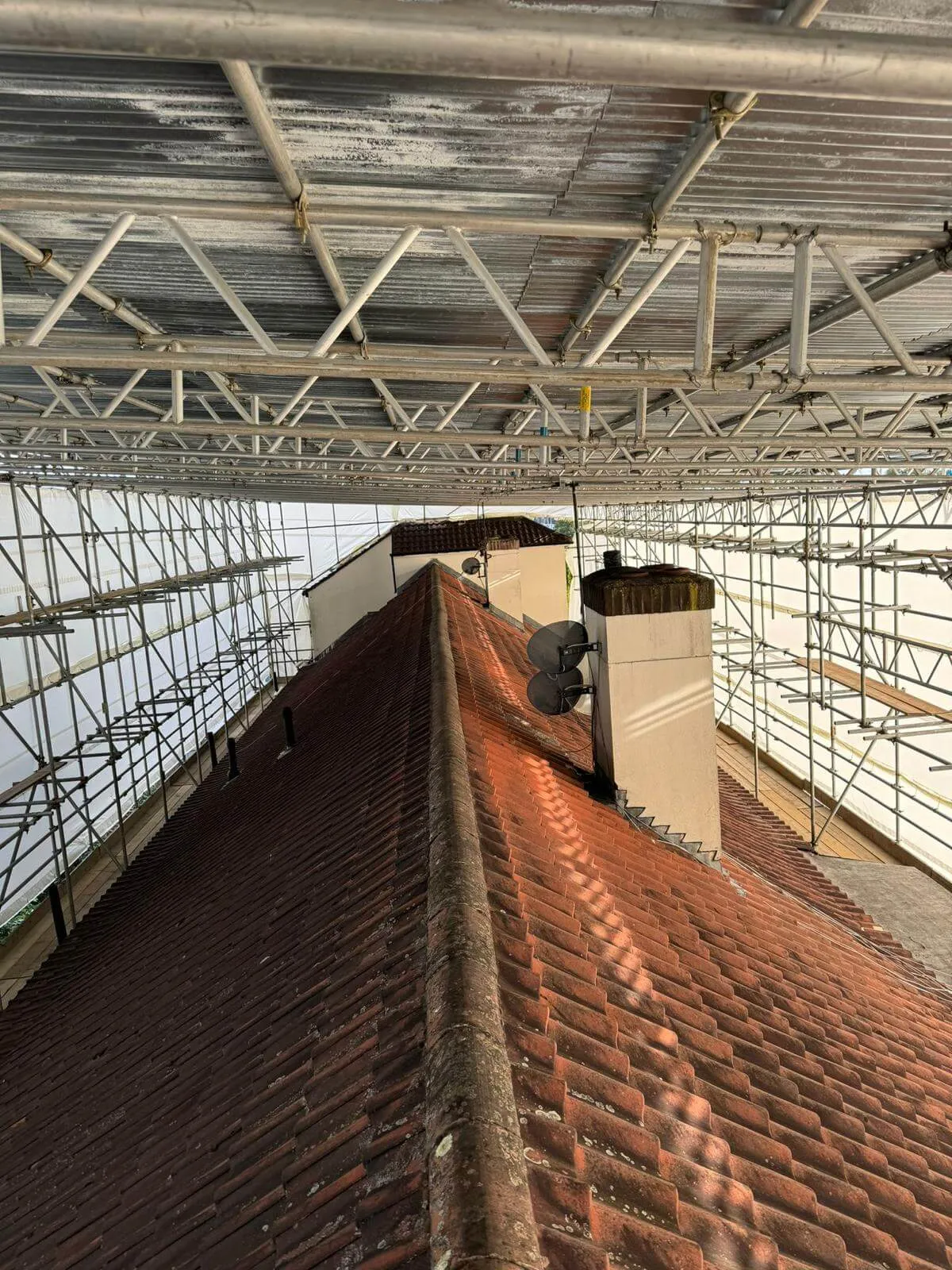
A temporary roof — sometimes called a scaffold roof or temporary roof system — is a free-standing pitched structure built over a building so the work underneath can continue in any weather. Aluminium beams span between scaffold towers on each side, purlins run across them, and the whole thing is covered with corrugated sheeting or shrink-wrap.
The key point for costing is that nothing about it is generic. The span, the pitch, the loading, the wind exposure and the way it ties into the supporting scaffold are all specific to your building. That is why you will rarely see a credible fixed price online, and why anyone quoting a temporary roof over the phone without seeing the property is guessing.
How a temporary roof quote is built up
A temporary roof quote is made up of four distinct parts. Understanding them makes it obvious why two quotes for the same house can differ.
- The supporting scaffold — full perimeter scaffold with enough lifts and ties to carry the roof loads, priced like any other scaffold hire.
- The roof structure itself — aluminium beams, standard or heavy-duty depending on the span, plus purlins, bracing and fixings.
- The covering — corrugated sheeting or shrink-wrap, chosen for the length of the hire and the level of protection needed.
- Design, erection and hire — a designed scaffold with drawings and calculations where the span, loading or wind exposure sits outside a standard configuration, plus the labour to build and strike it and the running hire cost.
| Element | Basis | Typical UK figure |
|---|---|---|
| Scaffolding hire | Per m² | £20–£25 |
| 2-storey semi-detached scaffold | Per week | £650–£1,100 |
| Pavement or road licence | Per month | around £140 |
| Sheeting or netting | Per m² per week | from around £5 |
As a benchmark for the scaffold element, UK hire averages roughly £22.50 per m² of scaffold. The roof is an additional structure over that, so budget for it as a separate line rather than a small uplift.
What pushes the price up or down
When we measure up for a temporary roof, these are the factors that decide where your quote lands.
- Clear span — the distance the beams must cross unsupported. Short spans use standard beams; long spans need heavier sections and often a full design, and the cost rises sharply.
- Plan area — the total footprint being covered, which sets the quantity of beams, purlins and sheeting.
- Height — the number of lifts in the supporting scaffold before the roof even starts.
- Pitch and shape — a simple duo-pitch over a rectangular building is the cheapest case; hips, valleys, dormers and irregular footprints all add work.
- Wind exposure — an exposed rural site or a tall building needs more bracing and heavier ties than a sheltered terrace.
- Access — whether the beams can be craned or lifted into position easily, or carried through a narrow side gate.
- Hire duration — a six-week roof and a six-month roof are very different commitments.
- Whether the roof needs to be openable or partially removable so materials can be craned in during the works.
When a temporary roof is worth the money
A temporary roof is a real cost, so it is fair to ask whether you need one. In our experience it pays for itself in these situations, and rarely disappoints anyone who chose it.
- Full re-roofs where the property will be open to the sky for more than a day or two.
- Structural timber repairs, where a single night of rain into exposed joists or a rotten wall plate can undo the work.
- Loft conversions and dormer builds, where you are living underneath the works.
- Listed and heritage buildings, where water damage to original fabric is expensive and sometimes irreversible.
- Winter programmes, where a tarpaulin will not survive a single storm and lost weather days cost more than the roof.
- Commercial and occupied buildings where the business underneath has to keep trading.
The comparison worth running is not roof versus no roof. It is the cost of the roof against the cost of weather delays, damaged materials, and a trade crew standing down for three wet days.
Temporary roof versus tarpaulin or shrink-wrap alone
Tarpaulin sheeting over the scaffold is cheaper, and for a short single-elevation job it can be enough. It is not the same product as a temporary roof, and the difference shows in wind.
A tarpaulin relies on the existing roof structure and on fixings that loosen. A temporary roof is a self-supporting frame designed for the loads it will see, which means the trades underneath can work in weather that would otherwise stop them, and materials can be stored dry on the deck below.
Shrink-wrap sits between the two. Wrapped to a proper frame it gives an excellent seal and a tidy appearance, which matters on high-street and heritage work. Wrapped to nothing in particular, it is just an expensive tarpaulin.
Sensible ways to reduce the cost
- Get the temporary roof designed at the same time as the scaffold, not bolted on afterwards — retro-fitting a roof to a scaffold that was not built to carry it costs more than doing it once.
- Confirm your trades' start dates before the roof goes up, so the hire period matches the works.
- Cover only what needs covering. A roof over the main range with sheeting to a lower extension is often the right answer.
- Combine the works. If the roof, the chimney and the leadwork all need attention, do them under one temporary roof.
- Ask whether a shorter clear span is possible using an intermediate support, if the internal layout allows it.
Frequently asked questions
How much does a temporary roof cost?+
There is no reliable fixed rate, because the price depends on the clear span, the covered area and the supporting scaffold. As a guide, expect the base scaffold to follow normal hire rates of roughly £20–£25 per m², with the roof structure priced on top as its own item. We give a firm written figure after a free site visit.
Is a temporary roof cheaper than tarpaulin?+
No — tarpaulin sheeting is cheaper up front. A temporary roof is a designed, self-supporting structure that keeps work moving in weather that would stop a tarpaulin job, so it is usually the cheaper option once you count lost days and water damage on anything longer than a short repair.
How long does it take to erect a temporary roof?+
On a typical domestic property, the supporting scaffold and the roof together usually take two to four days depending on span and access. Larger commercial structures and designed roofs are programmed with your main contractor.
Does a temporary roof need a design?+
Anything outside a standard configuration does. Long clear spans, unusual shapes, heavy loading and exposed sites all need a designed scaffold with calculations and drawings. We arrange that as part of the quote rather than as a surprise later.
Can I still get materials in and out under a temporary roof?+
Yes. Roofs can be built with removable sections or openings so tiles, timbers and plant can be craned in, and loading bays can be designed into the supporting scaffold.
Will a temporary roof stay watertight through winter?+
A properly designed and sheeted roof is built for exactly that. It is inspected on the same cycle as the scaffold beneath it, and sheeting is checked and re-fixed after severe weather.
A temporary roof is one of the few scaffolding items where the cheapest quote is almost never the right one, because the thing you are buying is confidence that the building stays dry while it is open.
Send us the address and a photo or two of the roof, and we will come out, measure the span properly and price it in writing. The visit and the quote are free, and we usually get to you within 48 hours.
Next step
Free site visit, free quote, usually within 48 hours
Tell us where the site is and what you need access to. We will come out, measure up and give you a price — no charge and no obligation.
Phone answered 24 hours · Free quotes · 12-week standard hire period